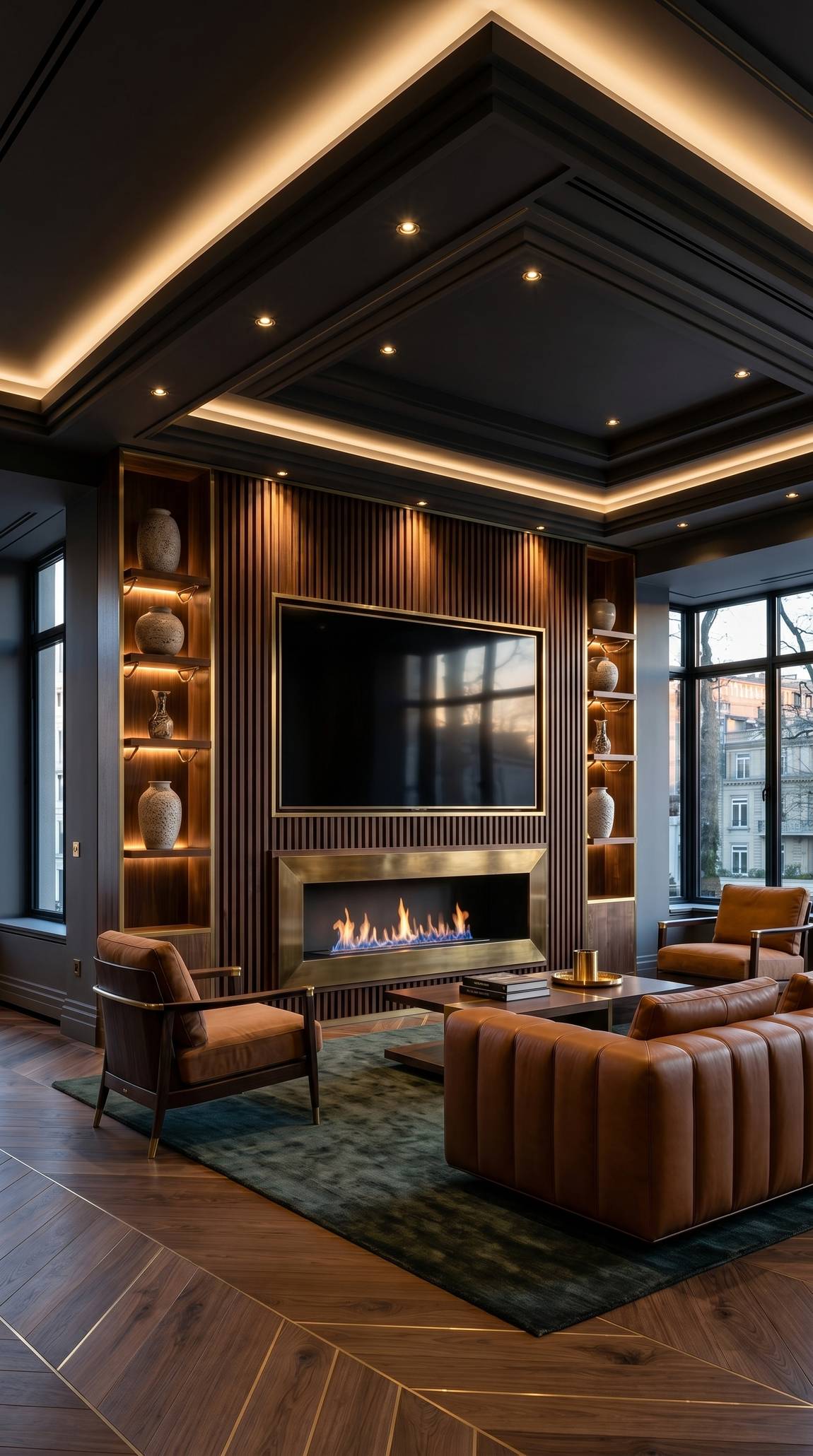
12 Luxury Media Wall Ideas That Look Five Times Their Budget
19 July 2026 · Updated 20 August 2026 · 10 min read
The difference between a media wall and a luxury media wall is rarely money — it's decisions. Panel spacing. Light temperature. Whether the cables exist in the visible universe. These twelve ideas are the ones that consistently make a wall look bespoke-joinery expensive, whether you're briefing a joiner or generating designs in the Aspire Interiors app to find your direction first. Each includes the materials that deliver it and the mistakes that ruin it.
What Actually Makes a Media Wall "Luxury"
Four things, in order: proportion (the wall is composed, not assembled), materials with presence (real or convincing stone, timber, metal), concealed everything (cables, boxes, routers, remotes), and layered lighting (never one light source). Every idea below is a variation on those four. Get them right and a £3,000 wall reads as £15,000; get them wrong and £15,000 reads as a TV on some shelves.
The 12 Ideas
1. The Monolith — floor-to-ceiling dark panelling
Vertical panels in near-black or deep charcoal, floor to ceiling, with the TV recessed flush so the screen becomes part of the grid. Materials: MDF panelling sprayed in a dead-matt finish, or real timber slats for texture. The mistake: stopping the panelling short of the ceiling — it turns a monolith into a wardrobe.


See it built: our black panelled media wall makeover, with the exact app fields to copy.
2. The Hearth — natural stone and a reclaimed mantel
The anti-cinema approach: a stone fireplace with a reclaimed timber mantel, TV integrated above or beside, niches instead of LED strips. Materials: stone veneer or real slip bricks, aged oak beam. The mistake:stone with a high-gloss TV frame — match the TV surround's temperature to the stone, not the showroom.


See it built: our warm stone media wall makeover.
3. The Gallery — shelving as architecture
Asymmetric display niches in varied sizes, each lit individually, styled with ceramics and books rather than ornaments-by-the-metre. Materials: plaster-finished recesses or timber boxes; miniature picture lights. The mistake:symmetrical cubbyholes — a grid reads "retail", asymmetry reads "designed".
4. The Marble Statement — bookmatched stone panel
A single bookmatched marble (or marble-look porcelain) panel as the centrepiece, TV mounted on the stone itself, flanked by plain plaster or timber. Materials: porcelain slab gives the look at a third of the cost and weight. The mistake: busy stone and busy panelling — one hero material per wall.
5. The Fluted Wall — texture through rhythm
Vertical fluted or reeded timber across the full wall, TV flush-mounted, lighting washing down the grooves. The texture does the decorating; everything else stays quiet. Materials: fluted MDF panels, oak or walnut veneer for the premium version. The mistake: fluting only around the TV — commit to the full width.
6. The Floating Composition — cantilevered console
A long, low floating media console with handleless doors, wall-mounted TV above, nothing touching the floor. The shadow gap underneath makes the whole wall feel weightless. Materials: bespoke or high-end flat-pack carcasses with sprayed doors. The mistake: visible brackets — the float is the luxury.
7. The Double Sided — room divider media wall
For open-plan spaces: a freestanding stud wall holding TV and fire on one side, shelving or a bar on the other. Materials: standard stud construction, double-boarded. The mistake: forgetting the back — both faces need a finish worth looking at.
8. The Collector's Wall — integrated display for actual collections
Vinyl, cameras, ceramics, first editions: deep niches sized to the collection, with museum-style lighting. Materials: depends on the collection's weight — real timber shelves for records. The mistake: lighting from above only; side or front micro-spots eliminate shadows.
9. The Hidden Cinema — TV concealed behind panels
Sliding or pocket panels that close over the screen when it's off; the wall becomes pure joinery. Materials: smooth-running pocket-door hardware is 80% of the cost and 100% of the feel. The mistake: flimsy tracks — this is a mechanism, not a cupboard door.
10. The Fireplace Line — extra-wide linear fire
A wide linear electric fire as the horizontal anchor, TV above with proper clearance, everything else minimal. Materials: quality electric fire (the flame effect is the whole game — see it in person before buying). The mistake: undersizing the fire; a 40-inch fire under a 75-inch TV looks apologetic.
11. The Curved Wall — radiused corners and soft edges
Curved end panels or a barrel-vaulted niche section — the 2026 move away from hard rectangles. Materials: bendable MDF or kerfed plasterboard for the curves. The mistake: curves on one side only; the eye reads asymmetry of form as an error.
12. The Library Wall — books floor to ceiling
The media wall for people who'd rather read: full-height bookcases flanking the TV and fire, styled by colour or chaos as you prefer. Materials: real timber shelves (books are heavy — 25mm minimum). The mistake:shelf depths that don't fit actual books — measure your tallest art books first.
Browse the 12 Styles
Prefer to start from a finished look? Each of these twelve styles has a full standalone tour with copy-ready app fields — pick one and steal the fields verbatim.
Fire or No Fire?
An electric fire adds roughly £500–£2,000 and complete atmosphere. Skip it if: the wall is narrow (under ~2.4m, the proportions fight), the room has another focal point, or the budget is better spent on materials. Include it if: this is the main evening room — the flame is what makes people choose this room after dinner. Both our media wall makeovers (black panelled · warm stone) include one, and both posts answer the heat-safety questions.
Lighting: Where Luxury Actually Lives
Three layers, always: ambient (LED cove or shelf wash, 2700K), task/accent (picture lights, niche spots), and the fire or screen itself. One circuit each, all dimmable, all warm — a single cool-white downlight grid is the fastest way to make expensive joinery look like a kitchen extension.
Getting the Size Right
TV: centre of screen at seated eye level (~100–110cm for most sofas). Fire: 300mm+ clearance below the screen, or hearth-mount it. Shelving: niches look best between 30–50cm; deeper than 35cm swallows objects. Console height: 35–45cm. Full step-by-step detail: our media wall walkthrough.
See It on Your Wall Before You Build It
Every idea here can be previewed on your actual wall: photograph it, upload to the Aspire Interiors app, and describe the design — or paste the exact fields from either of our media wall makeovers. Generate two or three directions, live with them on your phone for a week, then call the joiner. And when you're ready to build: our media walls service covers design through installation.
Frequently Asked Questions
How much does a luxury media wall cost in the UK?
Typically £2,000–£6,000 for a stud wall, joinery and fire from a good local joiner; £8,000–£15,000 or more for bespoke materials like real stone and bookmatched marble. The biggest cost lever is the joinery, not the fire (indicative ranges).
What is the most luxurious media wall material?
Real timber veneer and natural stone age best and photograph best. That said, sprayed fluted MDF and marble-look porcelain deliver 90% of the effect at a third of the cost — spend the difference on lighting, which is where luxury actually reads.
Do luxury media walls add value to a house?
A well-executed one does — it's the kind of feature estate agents photograph first. The key is quality of execution and proportion; a poorly-proportioned media wall is worse than none.
Can I design a luxury media wall with AI before building?
Yes — that's the sensible order. Upload a photo of your wall to the Aspire Interiors app and generate the design in place: proportion, materials and lighting on your wall, not a showroom's. Both our media wall makeovers started exactly that way.
Related Reading
Published: 19 July 2026 · Updated: 20 August 2026. By Mark Lunnemann — Founder, AutoMazen.ai. Built by AutoMazen.ai.