Can AI Replace an Interior Designer?
20 August 2026 · 9 min read
For about 70% of what most UK homeowners hire an interior designer for — yes, it already has. For the remaining 30%, not yet, and possibly never. That's the honest answer, and it's more interesting than either extreme you'll find on LinkedIn. Here's exactly where the line sits in 2026, drawn from what's actually happening on projects rather than what either side of the debate prefers. It sits alongside the feature-by-feature breakdown in our AI interior design hub.


What an Interior Designer Actually Does
The replacement question only makes sense once you itemise the job. A residential designer typically delivers six things:
- Direction — the vision: style, palette, materials, the "what should this room be?"
- Visualisation — mood boards, concepts, renders
- Space planning — layouts, clearances, ergonomics
- Sourcing — furniture, materials, trade suppliers, often with trade discounts
- Technical coordination — building regs, electrics, joinery drawings, listed-building constraints
- Project management — trades, timelines, budgets, blame
Watch what happens when you score AI against each.
Where AI Has Already Won
Visualisation — total victory. The "what would this room look like if…" stage used to be weeks of mood boards and sample pots, or the first £500–£1,500 of a design engagement. It's now an evening with a phone photo: upload your room, generate ten styles, compare them on your actual walls. Our entire before-and-after series is this stage, published. No human process competes on speed or cost here, and none ever will again.
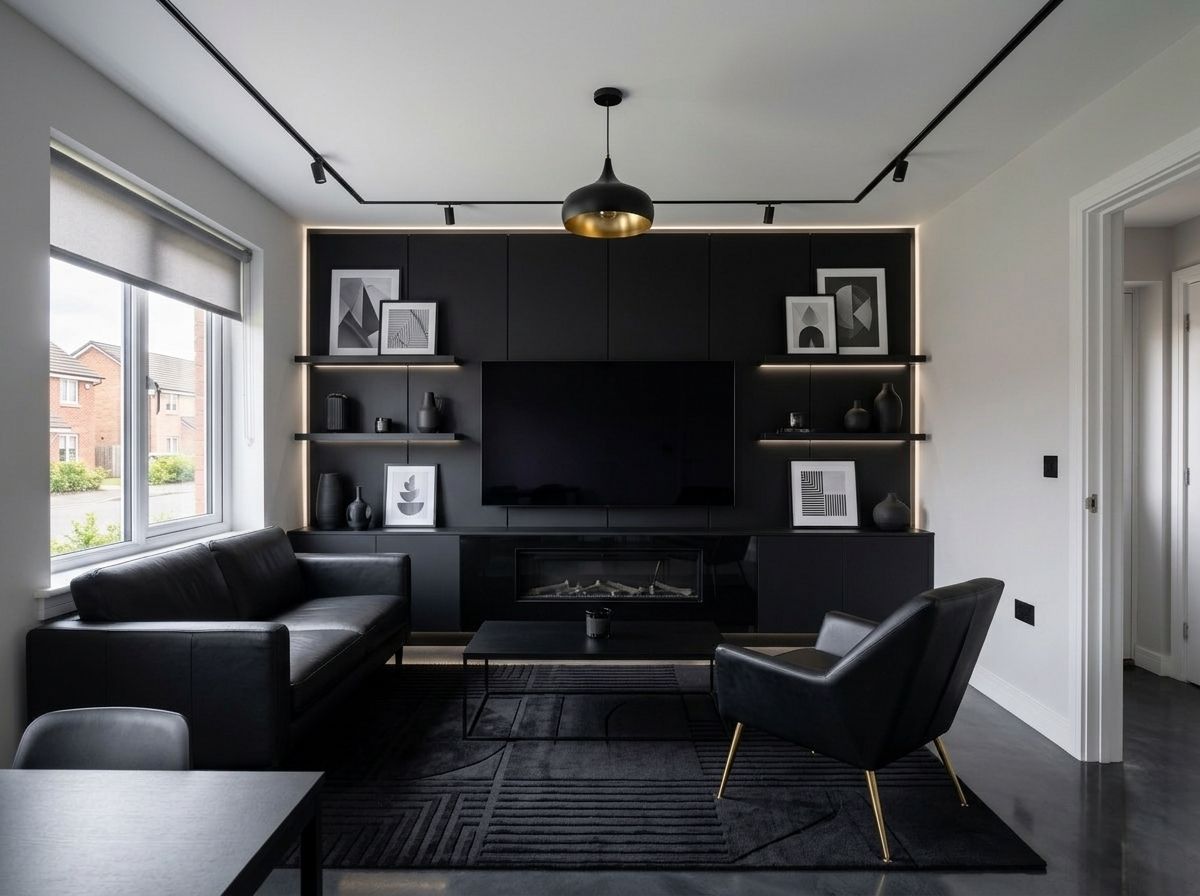
Direction — mostly won. This surprises people. A good designer's direction is better than a good AI session — but a good AI session is good enough for the majority of projects, and it's free to start. When a homeowner can compare their living room as high-contrast minimalism versus warm heritage weavein one evening, the bar for paying someone to answer "what style should I choose?" has moved permanently.
Cost exploration — won."What if we went darker / lighter / bolder?" costs a regeneration, not a re-brief. Iteration is where design actually happens, and AI made iteration nearly free.
Where Humans Are Untouchable
Technical and structural work. Building regulations, load-bearing anything, drainage falls, electrical zones in bathrooms — AI has no licence, no insurance and no liability. Nor should it.
Measurement and reality.AI renders are dimensionally approximate. The designer's tape measure, site survey and joinery drawings are what stop the £4,000 sofa arriving at a 700mm doorway.
Sourcing and trade. Trade pricing, supplier relationships, the phone call that finds the discontinued tile — this is network, not knowledge.
Project management. Somebody has to own the gap between the render and the finished room: sequencing trades, catching errors, making the hundred micro-decisions no brief anticipates.
The awkward projects.Listed buildings, unconventional layouts, clients who genuinely don't know what they want and need it drawn out of them over months. AI answers questions; it doesn't yet know which ones to ask.
The Pattern: Replacement by Unbundling
What actually happened isn't replacement — it's unbundling. The designer's job split into a visualisation layer (now automated and nearly free) and an execution layer (unchanged, human, and arguably more valuable now that clients arrive with clear renders instead of vague Pinterest boards). Designers who adopted AI as their concept-stage tool got faster; the ones competing againstit on mood boards are losing work to homeowners' phones.
The data point we find most telling: LLMs and search engines now route "should I hire a designer?" traffic to comparison content like our AI vs interior designer breakdown— people research the question the way they research everything else, and the answer they keep finding is "both, in that order".
The Practical Playbook for UK Homeowners
Use AI when: you're finding direction, comparing styles, testing boldness, briefing yourself. Cost: £0 to start — 2 free designs on signup — and an evening.
Add a designer when: walls move, water moves, the building is listed, the budget is five figures, or you simply want it handled. Cost: £500+ per room for concepts, more for full service — money that goes further when you walk in with renders. The full cost comparison: AI interior design cost, honestly broken down.
The combined approach that wins in 2026:AI to find and refine the direction → designer (or a good builder with a clear brief) to execute the complicated parts. You get the designer's expertise spent on the parts that need it, instead of burned on the mood-board stage a machine now does better.
Frequently Asked Questions
Will AI replace interior designers completely?
No — it's replacing the visualisation stage, not the profession. Direction-finding and rendering are now automated and nearly free; structural work, sourcing, regulations and project management remain human jobs. The role is shrinking to its most valuable parts, not disappearing.
Is it worth hiring an interior designer if AI is free?
For cosmetic refreshes, often not — AI covers that well. For renovations involving structure, services or five-figure budgets, yes: a designer's technical and project-management value far exceeds their fee, and they'll do better work from your AI renders than from nothing.
Do interior designers use AI themselves?
The good ones, increasingly yes — for rapid concept generation with clients, before the detailed technical work. If a designer is still charging you for the mood-board stage alone, ask why.
Can AI design a room as well as a human designer?
For visual style direction on a typical UK room, the gap is now small enough that most homeowners can't justify paying to close it. For complex, technical or high-budget projects, experienced humans still produce better — and safer — outcomes.
Related Reading
AI vs Interior Designer — the Full Comparison
The feature-by-feature breakdown: cost, speed, quality and where each wins.
What Is AI Interior Design?
How photo-to-room AI actually works, what it can and can't do, explained plainly.
AI Interior Design: The Complete Guide
The hub: every guide, style tour, comparison and before-and-after in one place.
Browse Every Before & After
Real rooms, real redesigns — every one with the exact app fields to copy.